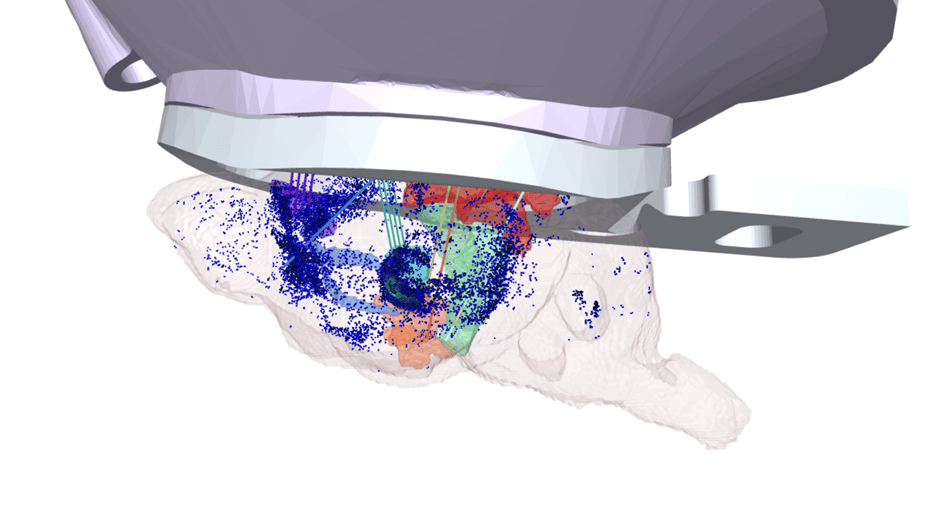
Foraging is an innate yet flexible behavior, and finding food and water is one of the oldest problems an animal has to solve. In the natural world, resources are rarely spread evenly: they come in patches, and each patch is depleted every time the animal takes from it. Animals must therefore keep deciding whether to stay and exploit the current patch or leave to explore other options. These decisions combine incoming sensory cues, such as the smell of food, with what the animal has learned from past experience. Because successful foraging is shaped by evolution, and because well-developed theories describe what an optimal forager should do, foraging offers a rich yet tractable framework for studying how the brain makes adaptive decisions.
A naturalistic patch foraging task for studying multi-regional activity across the brain
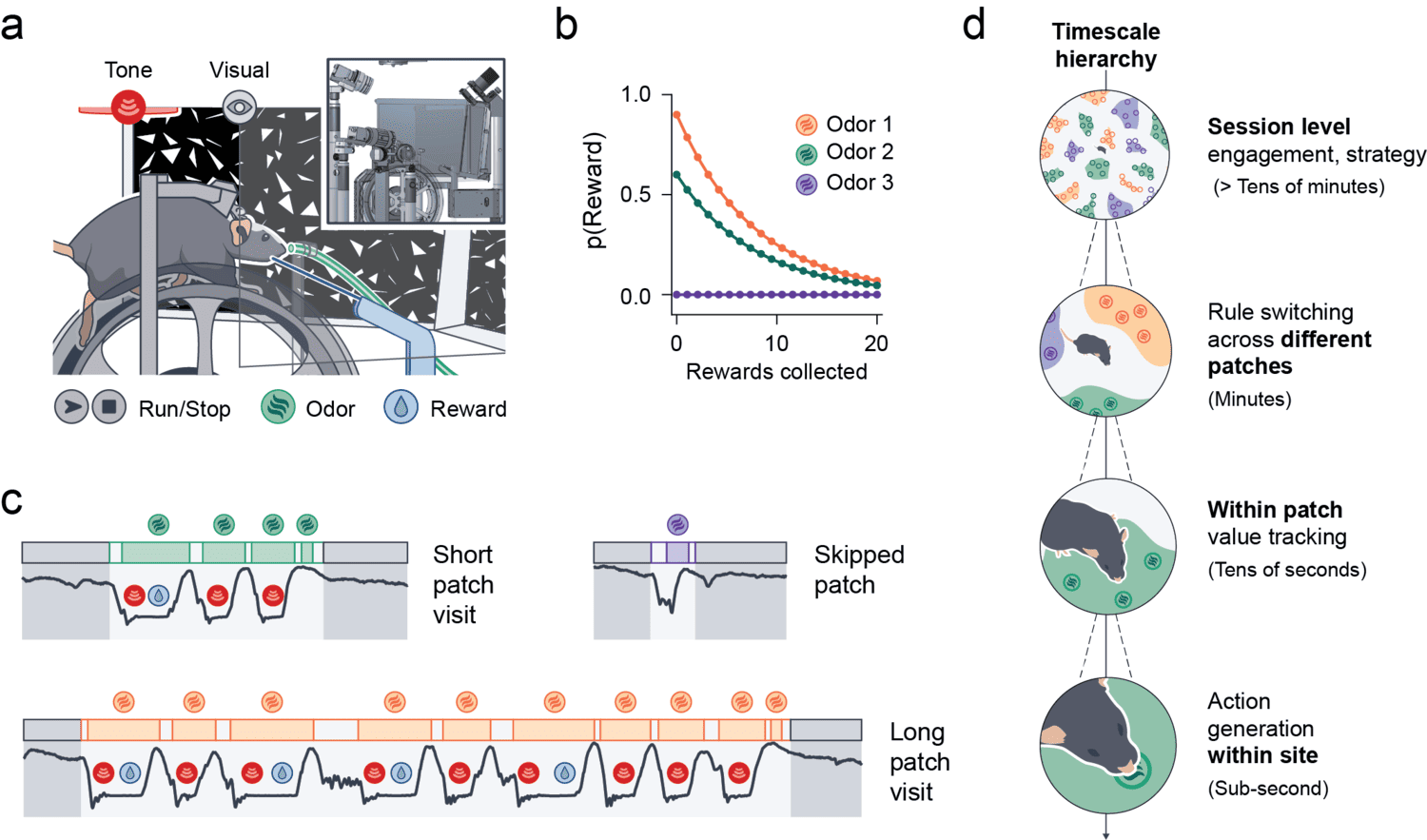
In nature, behavior unfolds as a continuous interaction between animal and environment, in which each choice shapes what happens next, rather than as a series of identical, independent episodes. We developed a head-fixed virtual reality patch foraging task that preserves the hierarchical and self-paced structure of natural foraging decisions, while maintaining a high level of experimental control and observation (Fig 1a). Mice traversed a virtual linear track and made self-paced choices to harvest probabilistic water rewards in locations cued by odors (Fig 1b). Naive mice rapidly acquired the task, learning to use odor identity and reward outcomes to make adaptive patch foraging decisions (Fig 1c). Behavior in this task is organized across many timescales: sub-second slowing and sniffing as a mouse anticipates an upcoming reward location, changes in reward expectation within a patch over tens of seconds, shifts in engagement over a behavioral session, and changes in the mouse’s strategy and internal model of the environment across days (Fig 1d). At any moment, continuous behavior reflects not only immediate sensory input but also an internal state that evolves across these nested timescales.
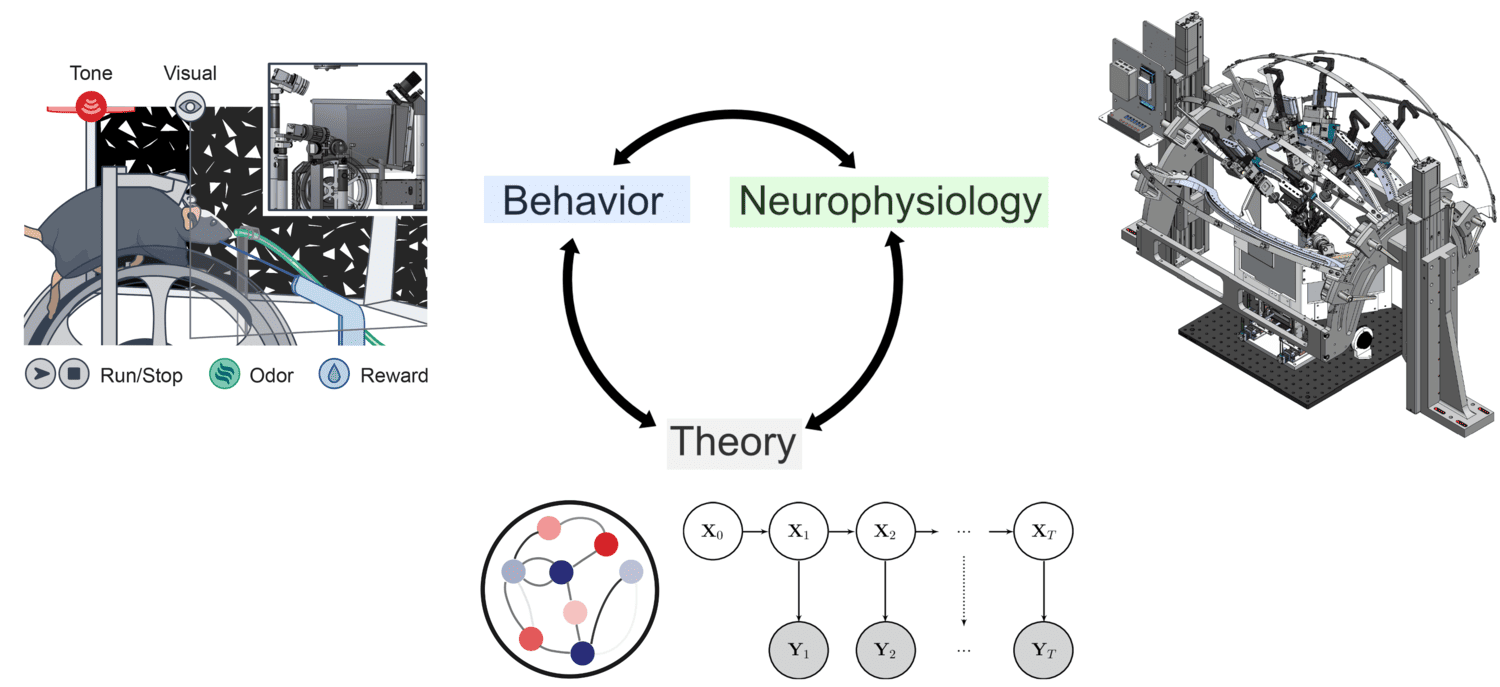
The task is designed to ground our understanding of brain-wide neural dynamics in naturalistic behavior. Because animals remain head-fixed while behaving flexibly, the paradigm gives stable access to multi-regional recordings and precise control over sensory experience. The continuous behavioral readouts also provide interpretable anchor points for neural analysis. Using this paradigm, we are combining brain-wide Neuropixels electrophysiology with cell-type-specific and neuromodulatory measurements. Theory and modeling approaches for understanding behavior, such as Bayesian inference, evidence accumulation models, task-trained recurrent neural networks, and multi-timescale state space models, inform experimental design and generate testable hypotheses for both behavior and neural data. Together, these approaches aim to reveal how coordinated activity across distributed circuits and cell types gives rise to adaptive behavior (Fig 2).
OpenScope Steering Committee
The OpenScope Steering Committee convenes at least biannually to provide crucial direction for the OpenScope project, playing an essential role in ensuring that we effectively serve our broader community.